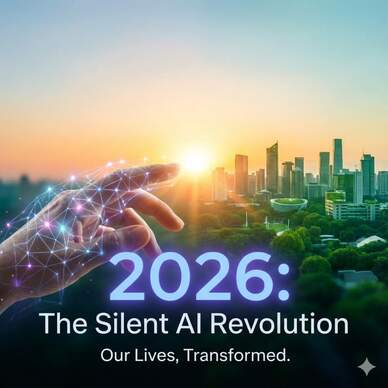
We are living in a world that, just five years ago, would have seemed like pure science fiction. As we pull back the curtains on 2026, we realize that Artificial Intelligence (AI) is no longer that loud, flashy novelty that dominated headlines with promises of either utopia or apocalypse. Instead, it has become something far more powerful: invisible.
In this post, we will explore how the deep integration of AI is shaping our health, our work, our education, and—most importantly—our way of connecting as humans.

1. From Reactive Assistant to Thinking Partner
Do you remember when we used AI just to generate a quick text or create a funny image? In 2026, that phase is long gone. Today, we interact with Agentic AI. The difference is fundamental: the assistant doesn’t just wait for a command; it understands context, anticipates needs, and acts as a true thinking partner.
This evolution has transformed personal productivity. It’s no longer about “doing more in less time,” but about “doing what truly matters.” Current systems manage our information overload, filtering out the noise and highlighting what requires our creative and emotional attention.
The Curation of Knowledge
With the explosion of machine-generated content, the great value of 2026 is curation. AIs now function as personalized librarians who know your learning history, your knowledge gaps, and your long-term interests. They don’t just deliver answers; they propose paths of discovery.
2. The Revolution in Healthcare: Longevity and Precision
One of the most impactful pillars of this decade is, without a doubt, AI-assisted precision medicine. In 2026, the concept of “going to the doctor only when you are sick” is becoming obsolete.
Real-Time Diagnostics
Thanks to next-generation wearables, AI monitors biomarkers in real time. Subtle changes in sleep patterns, heart rate variability, or even the chemical composition of sweat are detected weeks before any physical symptoms appear.
- Prevention: Predictive algorithms can identify risks of cardiovascular disease years in advance.
- Personalized Treatments: Medications are now adjusted according to an individual’s genetic profile, minimizing side effects and maximizing efficacy.
AI in healthcare does not replace the doctor; it liberates them from bureaucracy and routine diagnosis, allowing the medical professional to focus on what AI has yet to master: empathy, comfort, and clinical judgment in complex cases.

3. The New Renaissance: Work and Creativity
Many feared that AI would steal creative jobs. What we see in 2026 is the opposite: an explosion of human creativity empowered by generative tools. We are living through what some experts call “The New Renaissance.”
Human-AI Collaboration
In design, writing, music, and engineering, AI acts as a co-author. The human professional defines the vision, the ethical direction, and the emotional intent, while the AI executes the exhaustive technical iterations.
Table: The Evolution of Creative Work
| Field | Before Ubiquitous AI | In 2026 |
| Design | Hours spent adjusting pixels and layouts. | Focus on user experience and conceptualization. |
| Writing | Writer’s block and manual grammar checks. | Dialogue with AI to expand ideas and styles. |
| Programming | Manual writing of repetitive boilerplate code. | System architecture and high-level logic. |
| Education | Standardized teaching for everyone. | Hyper-personalized learning tracks. |
4. Education: The End of “One Size Fits All”
Education is perhaps the sector that has benefited most from the maturity of artificial intelligence. In 2026, the mass education model—where 40 students listen to the same lecture at the same pace—is being replaced by Adaptive Learning systems.
Every student has an AI tutor who knows their rhythm. If a student excels at logic but struggles with reading comprehension, the AI adjusts the teaching material to use logical examples when explaining literary concepts. This has democratized access to high-quality education, reducing learning gaps on a global scale.

5. Te Great Challenge: Ethics, Privacy, and Authenticity
It’s not all sunshine and roses. In 2026, we face ethical challenges that require constant vigilance. The line between what is real and what is synthetically generated has become almost invisible.
The Battle for Truth
Misinformation and sophisticated “deepfakes” necessitated the creation of new authenticity protocols. Today, blockchain technology is frequently used to verify the origin of sensitive content. Furthermore, data privacy has become the most valuable currency on the market.
The Value of “Human-Made”
Ironically, the more perfect AI becomes, the more we value human imperfection. In 2026, there is a premium market for products, texts, and art that carry the “Fully Human” seal. Error, subjectivity, and the unique life experience of a person have become valued luxuries.
6. Smart Cities and Sustainability
AI has also taken over the nervous systems of our cities. In 2026, energy management, urban traffic, and waste collection are optimized by neural networks seeking maximum efficiency with minimum environmental impact.
- Energy Grids: Systems that redistribute solar and wind electricity in milliseconds to where it is most needed.
- Mobility: Fleets of electric autonomous vehicles have drastically reduced the need for parking lots, returning green space to pedestrians.

Conclusion: The Human at the Center of Everything
As we look toward the horizon of 2026, the most important lesson we’ve learned is that Artificial Intelligence is not about machines replacing people. It is about machines giving us back what is most precious to us: time and potential.
By delegating repetitive tasks, massive data processing, and complex logistics to algorithms, we are forced—in a positive way—to rediscover what makes us human. Creativity, compassion, philosophy, and the search for purpose have never been more important.
AI is the mirror we created to better understand our own minds. And in 2026, that mirror is showing us that our future is as bright as our capacity to collaborate with the tools we build.
What do you think of this vision of 2026?
Has technology already changed something in your routine this year? Leave your comment below and let’s discuss how we can use these innovations to build a fairer and more creative world.
Did you enjoy this post?
If you want to see the described images come to life or need help adapting this content for your specific niche, I am here to help!